
The problem with the words “automation” and “AI” is that it sounds like you’re being replaced, and it suggests that machines work better than humans. In reality, it’s about reclaiming time and using that time for more enjoyable and creative tasks that help drive the business forward in ways only humans can.
You weren’t hired for the admin
Most people spend a lot of their days on administrative, recurring tasks that are draining but don’t necessarily add value to the business. These tasks need to be done, but they are not why the business hired you. They hired you for your creative and strategic thinking. By spending all day on recurring work, you’re unable to focus on what you’re really good at.
Machines excel at repetitive, task-driven work. By outsourcing these tasks to machines and automating them, you free yourself up to spend more time on the things you should be doing.
What this actually looks like
The dominant no-code automation platforms, like Zapier and Make, let you connect two online applications together and move data between them.
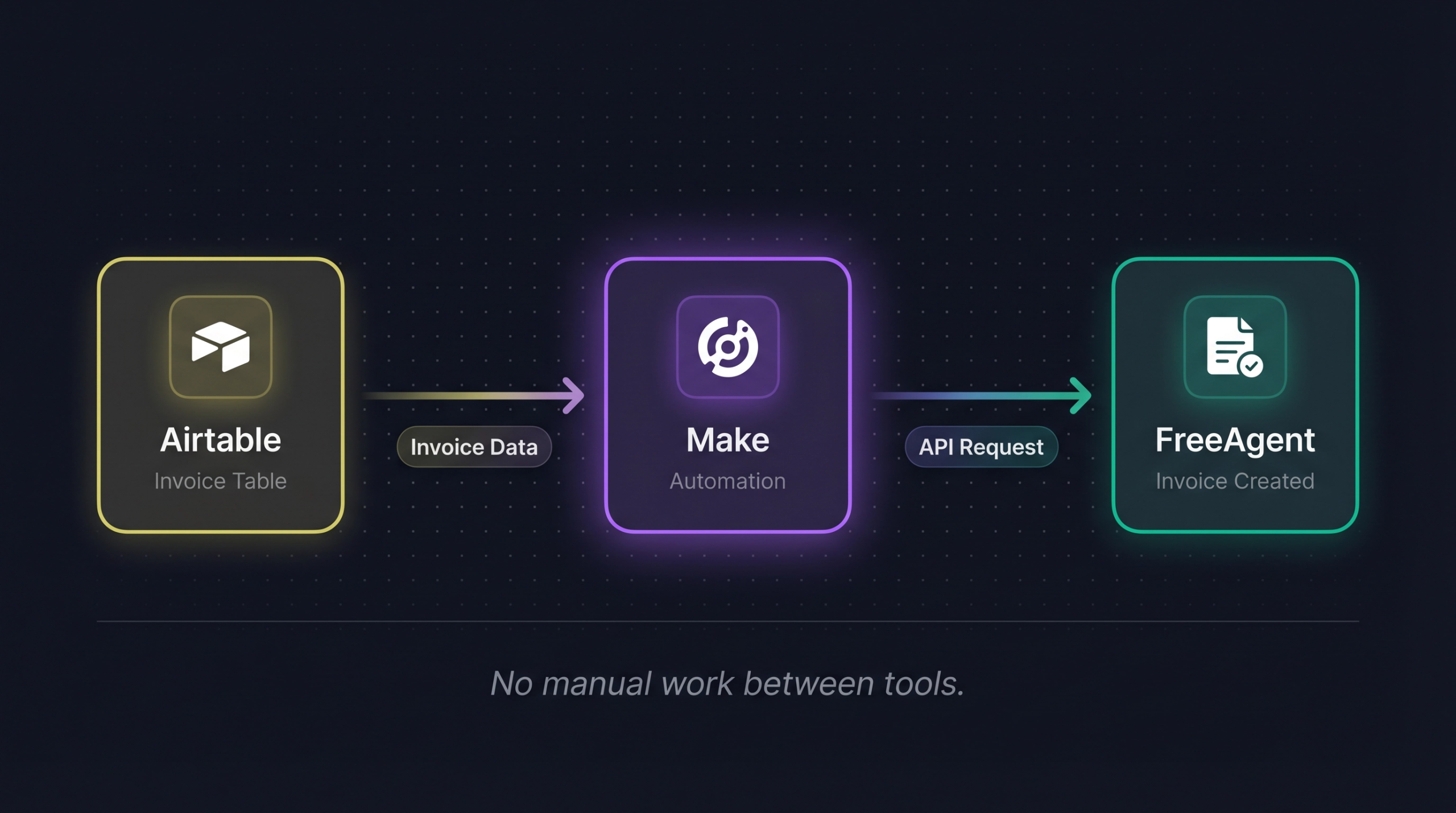
Here’s a concrete example from my own work. I have an invoicing table in Airtable where I collate all the information I need for an invoice. Rather than going into FreeAgent and manually creating that invoice, I have an automation in Make that takes the invoice data from Airtable and communicates with the FreeAgent API to create the invoice automatically. That eliminates any manual work between those two tools.
Other administrative recurring tasks that you can automate:
- Expense reporting
- Scheduling social media posts
- Triaging your inbox
- Moving data into your accounting software
- Moving tasks from your to-do list to planning app
There’s also AI-assisted work, which is slightly different from workflow automation. It’s a version of automation, but instead of connecting apps, it uses AI. With Claude, for example, you can use a feature called Claude Skills, where you write down a repeatable process or workflow in natural language and then run a command to execute it every time.
The hard part
In all fairness, it’s harder than it looks, because in reality many people don’t know which tasks they want to stop doing or which tasks can actually be automated. This, in itself, is part of the challenge.
So start by sitting down and making a list of everything you do on a daily and weekly basis, then identify which ones you believe could potentially be automated. You can use a blank piece of paper, a notes app, a mind map, or ask AI for help — you can use Claude and ask it to help you refine your automation ideas by asking questions about your work.
When prioritising, consider two things: the amount of time saved for you and your team, and the wider business impact – whether that’s increasing revenue or removing bottlenecks that are getting in the way of serving your customers. Work through the list starting with the tasks that score highest on both.
Where to start
Pick one small thing — expense reporting, social media scheduling, moving tasks between apps — and experiment with Zapier or Make. Starting is better than not starting at all, so begin automating a few tasks and see how it goes.
If you want ideas for your first automation, sign up for my newsletter. I send out automation ideas every week and you can choose one to start with.
Marketing Automation Weekly
Each week I share a behind the scenes look at the real automated marketing systems I build for marketing teams.
You’ll get practical insights and examples on streaming marketing operations, getting data into the right systems and freeing up your team to do more creative work with the help of automation and AI.